Book review: ‘Periodized Sports Psychology’ is not about shortcuts

Canada's Dana Ellis is cover girl.
I watched a lot of Vancouver coverage with perverse curiosity. Where did the bobsledders get the guts to go down that deadly run? How did that Canadian figure skater overcome her emotions after her mother died? How did Shaun White get that superconfidence to execute those half-pipe tricks? Although Brian Risk wrote “Periodized” before the Olympics, he’d probably answer all these questions with: “Duh, they prepared.” Many books touch on mental prep, but few have focused so carefully and comprehensively as Brian’s. And contrary to what you might expect, mental training is far more than mental tricks. Properly done, it’s woven into the fabric of everyday skill and strength training. And like all training, it gets more challenging as the season progresses. Masters track isn’t mentioned, but the book applies to all athletes. Brian was a Canadian coach at the 1996 Olympics and has a lot of great credits. Best of all, he got track coaching legend Loren Seagrave to write a three-page Foreword. Nuff said.
Read the rest of this post »


Book Review Week: Check out my takes on masters titles
Starting tomorrow, I’m reviewing seven books worthy of your attention — all relevant to masters track. Listed alphabetically by author, the titles are: “Second Wind: The Rise of the Ageless Athlete” by masters sprinter and newspaperman Lee Bergquist, “Masters Athletics: Social, Biological and Practical Aspects of Veterans Sport” by Krzystof Kusy and Jacek Zielinski, “The Ultimate High Jump Book” by masters jumper and coach Ron Lee, “Creating Amazement: The O’Meara Process at Work” by masters miler David O’Meara, “The Masters Athlete” by Peter Reaburn, “Periodized Sport Psychology: Building the Bulletproof Athlete” by Brian Risk and “Running on Third Wind” by longtime National Masters News columnist and masters runner Mike Tymn. I’ll roll these out in a different order, however. Once a day. I’ll be on vacation and may not have Internet access everywhere, so enjoy these reviews — written in advance. Some are new, some not so new. But all take masters track seriously.

Just in time for spring reading: Seven books of interest to masters.
Ralph Maxwell going where few hurdlers have gone before: past 90
The USATF preview of Boston indoor nationals starting today focuses on the big names – the Raschkers, Collinses, Hanscoms, Shaheeds, etc. But my attention will be riveted to results of an event scheduled for 4:35 p.m. local time Saturday: the men’s 80-94 60-meter hurdles. If Ralph Maxwell competes as suggested by his entry, he will make history — the first American 90-plus to contest this event. Of course, any legal mark will be the M90 American record. If he gets over five 27-inch hurdles and beats 17.56, he’ll claim the world record now held by Ilmari Koppinen of Finland. At Kamloops, the oldest hurdler was Horst Albrecht of Germany. He’s 86. In the M90 hurdles, Emmerich Zensch of Austria was a scratch. (See results here.) Outdoors, I count three M90 hurdlers: the late Bert Morrow, Kizo Kimura of Japan and Ilmari. Quite an exclusive club. Best of luck to all the hurdlers at Boston, and everyone else!
M90 Ilmari Koppinen of Finland, running the 80-meter hurdles at Lahti worlds, paves the way for Ralph Maxwell at Boston -- among the oldest hurdlers in history. (Photo by Ken Stone)
USATF offers $220,000 in grants — and masters invited to apply!
 OK, it’s put-up-or-shutup time. Masters athletes, clubs and organizations have been invited to apply for a share of $220,000 in “challenge grants” from USA Track & Field. This apparently is part of the program telegraphed at the last annual convention. It’s not under the USATF Foundation, which snipped “masters” out of its mission statement. Complete info is here. But here is the key element: “Any individual, institution, club, association, committee or other entity can apply. Applications must be submitted by a member of USATF.” One idea: Helping underserved regions put on masters track meets. Go get ’em! Deadline is May 15.
Scottish gent won 2 throws golds at Kamloops — after stroke
Comebacks from injury are part and parcel of masters track. Some go the extra mile, getting heart transplants or new knees. But this story from Scotland just frightens me: “A retired athletics coach from Edinburgh has become a double world champion hammer thrower – in his first competition after suffering a stroke. Bill Gentleman, 70, who famously discovered Scots legend Yvonne Murray and set her out on the track to running success, suffered the stroke in July 2008.” He won two golds at Kamloops — in the 4-kilo hammer (47.33/155-3) and 16-pound weight throw (16.68/54-8 3/4). Not all strokes cause paralysis, I realize. But I’d be worried about doing more damage. I once took a half-paralyzed stroke victim (a church friend) to weekly swim therapy. I got him into his suit and went into the water with him, and then got him dressed afterward and drove him home. Such a sad sight. Mr. Gentleman, take care!
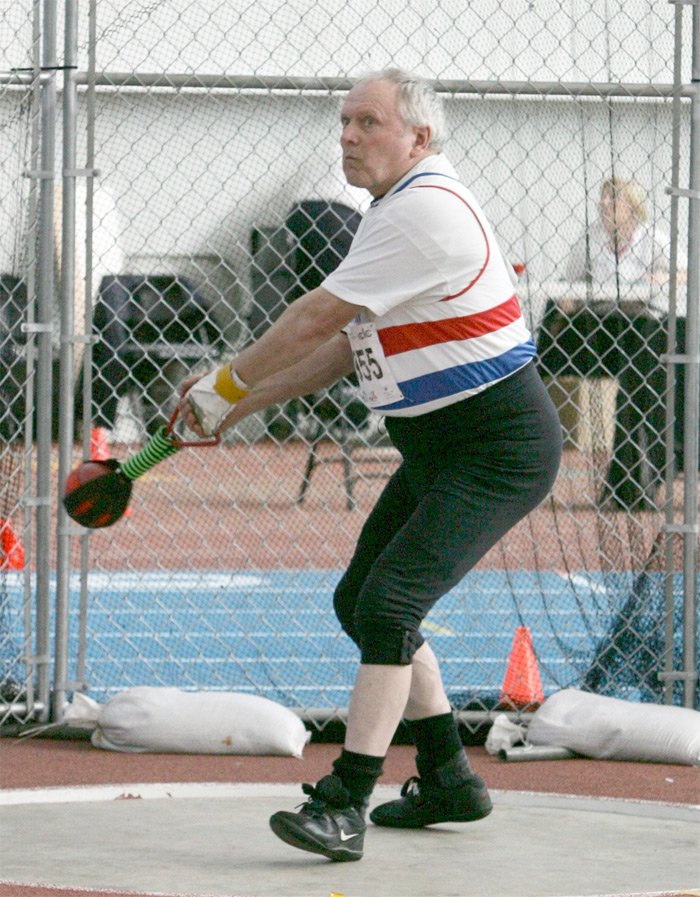
Here's Bill Gentleman at Kamloops. (Photo by Lesley Richardson)
Read the rest of this post »
Nolan Shaheed joins the kiddies in Sports Illustrated’s latest FITC
Nolan Shaheed gets his 15 seconds of fame in the current (March 29) issue of Sports Illustrated. See “Faces in the Crowd” on page 18. The SI folks wrote to USATF, seeking a portrait, and they used the big smile I shot at 2008 Spokane nationals. Cool! Nolan was celebrated not for his latest mile and 1500 records but for his medals at Kamloops. You can tell SI looked at the meet results because they refer to him “running the third leg of the winning 4×200 relay in the men’s 60-99 division.” Of course, there’s no such thing as a 60-99 age group. But the Kamloops results site listed a bunch of relays with this -99 glitch. Oh well. It’s all good. Congrats, Nolan! Do us proud in Boston.
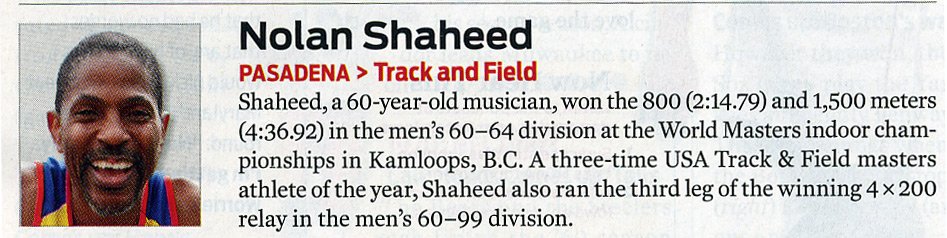
Nolan is having a great M60 debut season, and it can only get better.
Four world indoor records reported at Nordic champs in Jyväskylä
Jyväskylä, Finland, site of the 2012 WMA world indoor meet, saw four world records last weekend, report the Koops in Gemany. They write of the Nordic championships: “Along with a number of national records (including nine Finnish national records) showed high levels of these two world records . . . The Finn Leo Saarinen improved in his hometown of his own M80 shot put record set in January this year to 13.68 meters (44-10 3/4). Ilpo Sopanen (M75) increased the pole vault world record of four years old (Bud Held, USA) by two centimeters to 2.92 meters (9-7). The M80-winning high jump Samuli Korpi (FIN) with strong 1.35 (4-5) bettering the 1.31 previously by Nils-Bertiv Nevrup, Sweden, and his wife Irene Merjamaa (W75) won the weight throw (4 kg) with an impressive 10.40 (34-1 1/2), previously 9.54 (31-3 3/4) by Kaija Jortikka, Finland.” Results are here for the three-day meet that attracted 463 (mainly from Finland).
Bill Murray, Rita Hanscom are USATF Masters T&F Athletes of 2009
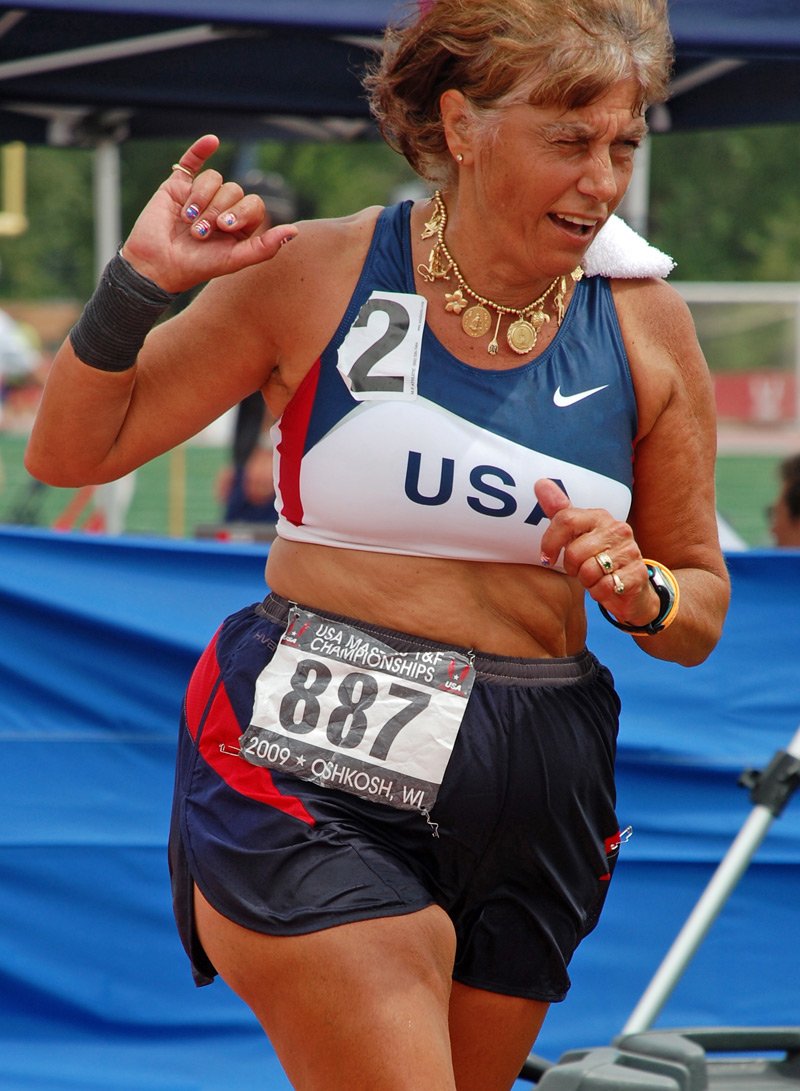
Mary at Oshkosh in full Bohemia TC regalia. (Photo by Ken Stone)
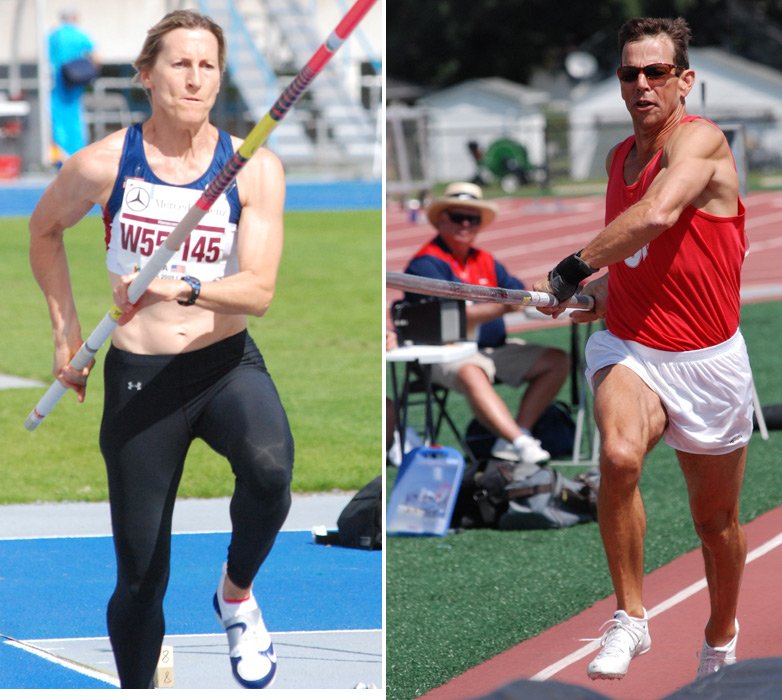
In 2009, Rita (at Lahti) and Bill (at Oshkosh) were the queen and king of American multi-eventers. (Photos by Ken Stone)
Read the rest of this post »
Have faith, folks! Track season is right over that next snowdrift!
Jerry Smartt of Warsaw, Missouri — our favorite 1950s world-class distance ace — took the picture below on March 21. Yeah, the first full day of spring. He wrote: “Hey, Ken, no steeple practice for a while.” While I doubt a steeple barrier is depicted, I get the point. But don’t cry for Jerry, Argentina. He still trains seriously. Asked about his current regimen, he writes: “It’s all outdoors. The closest ‘rubber’ track is 40 miles, so I never get over there. I train on an asphalt oval that measures one mile and 100 yards. My measuring wheel is in feet so I have the oval marked with spray paint. I have the start/finish of one mile, 110, 220, 440, 880, and 1K. I train twice a day and I do all kinds of repeat intervals. As the weather warms, I’ll work up to a total of ten miles a day. At almost age 79, I’ve learned that really ‘fast’ speed work can be unhealthy. Instead of 110s in 23 (fast for me), I’ll swing through in 27-28.”

Jerry's scenery in west-central Missouri doesn't look hospitable to track.
Offer your advice to W55 athlete on hormone replacements
OK, folks. Now comes the hard part in the doping debate. How do you answer the lady who posted a question on the entry telling Gary Snyder’s plans for USATF masters drug-testing at nationals? The anonymous commenter wrote: “I am a w55 competitor who has been on doctor prescribed hormone replacement therapy for over 10 years. The medication I take has eliminated severe symptoms of migraines, bipolar mood swings, and other debilitating problems. I love competing, have made many friends and am not a cheater. What am I to do?” Of course, some hormone replacements might be kosher. Others, like the stuff Kathy Jager was taking in 1999, contain banned substances. So now let’s get real. What do you tell “w55 competitor”? Read the rest of this post »